Former U.S. diplomat Christopher Hill returns to Albania for memoir launch, reflects on legacy in the Balkans
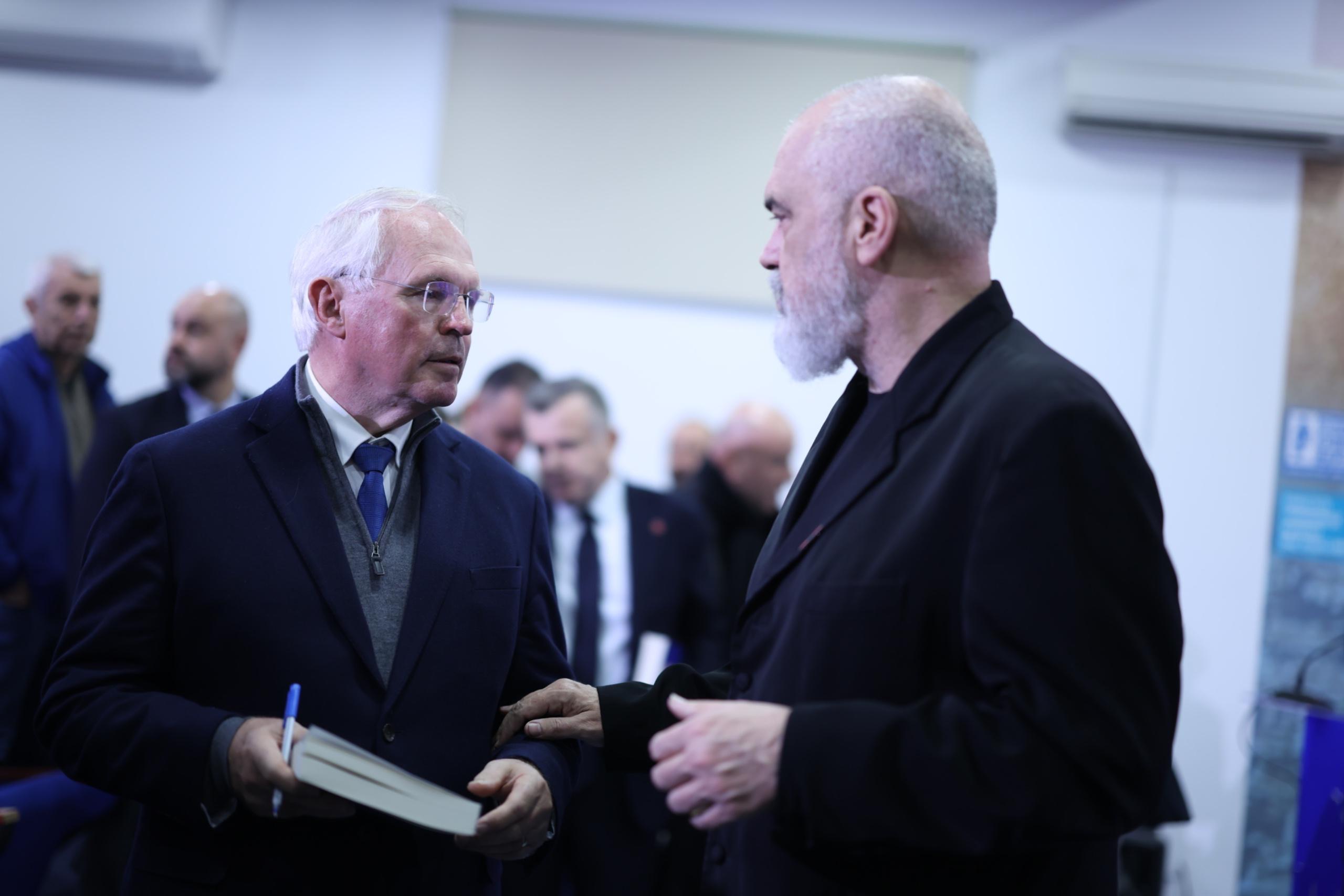
Nearly a year after concluding his term as U.S. Ambassador to Serbia, veteran American diplomat Christopher Hill returned to Albania this week to promote the Albanian translation of his memoir, “Outpost: Life on the Frontlines of American Diplomacy.”
Why is this important: Hill, a key figure in U.S. foreign policy in the Balkans and beyond, is best known in Albania for his role in reestablishing diplomatic ties between the U.S. and Albania after March 1991, after decades of communist isolation. His return, now as an author rather than an envoy, has reignited interest in his legacy and influence across the region.
Context: Hill’s long career in the U.S. Foreign Service includes stints as ambassador to North Macedonia and Serbia, and negotiations in some of the most complex international hotspots. His book includes personal reflections on his time in the Balkans, a region he came to know intimately.
At the Tirana launch of the memoir, Prime Minister Edi Rama offered candid remarks, admitting he had not yet read the book, but shared the early impression many Albanians had of Hill during the post-communist transition.
“When I first heard his name,” Rama recalled, “people were saying Hill had sent Fatos Nano to prison. That was a pretty powerful way to leave a mark.”
He went on to distinguish Hill from other American ambassadors who have served in the region, describing him not as a “prima donna” but rather a quiet “ghost” figure who maintained influence through subtle diplomacy.
“If I were to write a book about American ambassadors in the Balkans,” Rama joked, “it would be called ‘Ghosts and Prima Donnas.’ Hill would be the ghost – always present, never loud, and far more effective for it.”
What was said: Taking the podium, Hill addressed these long-standing rumors directly.
“I appreciate that the Prime Minister mentioned not only the things I did, but also the things I absolutely did not do,” he said, firmly denying any involvement in legal actions against political figures during his time in Tirana.
Rama praised Hill’s diplomatic style, saying he stood out among American envoys for his restraint and ability to listen—qualities he suggested are rare.
“Being a U.S. ambassador in Albania is probably the second-best job for an American, after being president – you’re treated like a god,” Rama said. “But Chris did that job with calm, with distance, and with real attention to listening.”
Reflections on Serbia and the region: The Prime Minister also acknowledged the difficulty of Hill’s most recent post in Belgrade, describing it as a “nearly impossible” assignment given the region’s persistent instability.
He closed his speech by quoting a line from Hill’s memoir that he felt captured the Balkan dilemma:
“A problem between two countries may seem like a late-night comedian’s joke – but in the Balkans, there’s nothing funny about it.”
Background: Christopher Hill played a pivotal role in shaping U.S. engagement in Southeast Europe in the 1990s and early 2000s, especially during the post-war transitions in Kosovo and Macedonia. His experience later extended to high-profile roles, including Assistant Secretary of State for East Asian and Pacific Affairs and chief U.S. negotiator in the North Korea nuclear talks.
Go deeper
Erion Veliaj’s lawyers urge Constitutional Court to fast-track review amid concerns over capital’s governance

Published on December 13, 2025
Why is this important: The request places renewed pressure on the Constitutional Court to address one of the most contentious cases to emerge from Albania’s justice reform. Veliaj has been held in pre-trial detention since February, while the capital city is effectively governed in his absence by a deputy mayor. His lawyers argue that continued delays undermine constitutional guarantees, democratic representation, and the effective administration of Tirana, making the court’s timing as consequential as its eventual ruling.
Albanian Constitutional Court reinstates Deputy PM, redraws the line between judiciary and government

Published on December 12, 2025
Why is this important: While not a final ruling on the substance of the corruption case against Balluku, the decision represents a landmark institutional moment—one that redefines the limits of judicial reach into the executive branch. The case will now proceed to a full public hearing on January 22, where the Court will consider Prime Minister Edi Rama’s appeal for a constitutional interpretation of the powers of prosecutors and judges to suspend sitting cabinet members.
Albania proposes new rules to screen foreign investments in sensitive sectors

Published on December 9, 2025
Why is this important: The draft regulation introduces detailed procedures to assess and, if necessary, block or condition foreign investments that could pose risks to public order, national security, or Albania’s informational sovereignty. It signals growing concern about hybrid threats – including cyberattacks, disinformation, and data leaks—that could exploit vulnerabilities in strategic sectors.