Albania proposes new rules to screen foreign investments in sensitive sectors
The Albanian government has opened public consultation on a new regulation aimed at tightening controls over foreign direct investments in critical sectors such as infrastructure, energy, technology, sensitive data, and media. The move is part of broader efforts to align with EU standards and safeguard national security.
Why is this important: The draft regulation introduces detailed procedures to assess and, if necessary, block or condition foreign investments that could pose risks to public order, national security, or Albania’s informational sovereignty. It signals growing concern about hybrid threats – including cyberattacks, disinformation, and data leaks—that could exploit vulnerabilities in strategic sectors.
Context: According to the Ministry of Economy and Innovation, the regulation seeks to strike a balance between attracting foreign capital and protecting the public interest.
“Hybrid threats from cyberattacks, disinformation, and data leaks have become a real risk to national security,” the Ministry said in its statement. “Under these conditions, investments in media and information sectors must be treated with special care to avoid harmful influence.”
The regulation foresees the creation of an Interministerial Committee for Investment Review, which will include representatives from Albania’s security, economic, and technology institutions. This committee will have the authority to examine any investment involving a sensitive sector and determine whether it should be approved, conditioned, or blocked altogether.
“Investments related to critical infrastructure, sensitive technology, access to information, or media freedom will be assessed for potential risk to public order and security,” the Ministry added. “Authorization will become a prerequisite for licenses, public contracts, and participation in tenders.”
EU alignment: The regulation aligns with Chapter 30 of Albania’s EU accession obligations, which focuses on external relations and economic cooperation, including the screening of foreign investments. It does not impose additional costs on the state budget, according to the accompanying policy note.
In an era of increasing geopolitical tensions and digital vulnerability, Albania joins a growing list of countries establishing screening mechanisms for foreign investments, particularly in areas where foreign influence could pose systemic risks.
Go deeper
Erion Veliaj’s lawyers urge Constitutional Court to fast-track review amid concerns over capital’s governance

Published on December 13, 2025
Why is this important: The request places renewed pressure on the Constitutional Court to address one of the most contentious cases to emerge from Albania’s justice reform. Veliaj has been held in pre-trial detention since February, while the capital city is effectively governed in his absence by a deputy mayor. His lawyers argue that continued delays undermine constitutional guarantees, democratic representation, and the effective administration of Tirana, making the court’s timing as consequential as its eventual ruling.
Albanian Constitutional Court reinstates Deputy PM, redraws the line between judiciary and government

Published on December 12, 2025
Why is this important: While not a final ruling on the substance of the corruption case against Balluku, the decision represents a landmark institutional moment—one that redefines the limits of judicial reach into the executive branch. The case will now proceed to a full public hearing on January 22, where the Court will consider Prime Minister Edi Rama’s appeal for a constitutional interpretation of the powers of prosecutors and judges to suspend sitting cabinet members.
Former U.S. diplomat Christopher Hill returns to Albania for memoir launch, reflects on legacy in the Balkans
Published on December 5, 2025
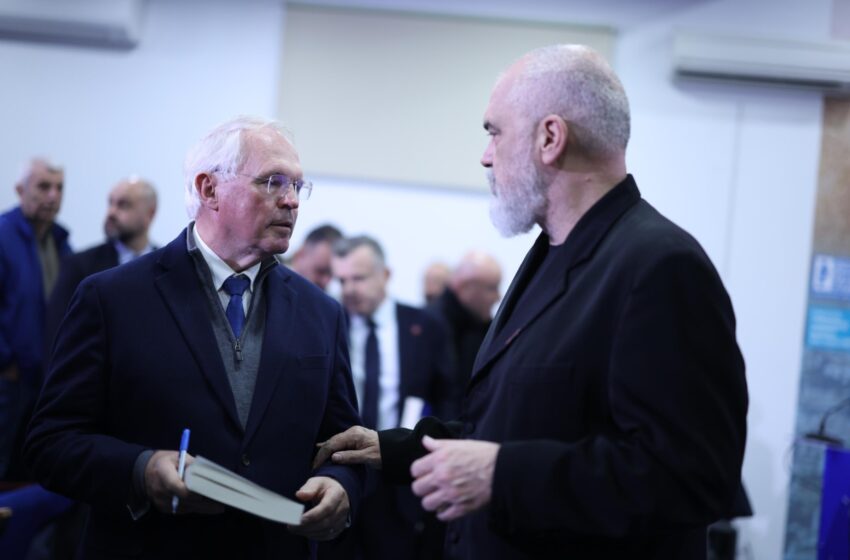
Why is this important: Hill, a key figure in U.S. foreign policy in the Balkans and beyond, is best known in Albania for his role in reestablishing diplomatic ties between the U.S. and Albania after March 1991, after decades of communist isolation. His return, now as an author rather than an envoy, has reignited interest in his legacy and influence across the region.